

You signed a vendor contract months ago, the work changed twice, and finance still can’t tell what the company agreed to buy. That’s where a master service agreement matters, not at signature, but in the months after it lands in a folder and starts shaping spend.
Table of Contents
- Liability sets the loss boundary
- Termination controls the exit
- Data protection and service levels drive daily risk
- Ambiguous scope creates open-ended cost
- One-sided commercial terms weaken your position
- Auto-renewal traps hide in routine language
- Step one, build one contract register
- Step two, extract the fields that matter
- Step three, assign owners and review dates
What Is a Master Service Agreement
A master service agreement is a contract that sets the standing rules for an ongoing vendor relationship.
That definition sounds legal. The practical version is easier. The master service agreement is the rulebook for how your company and a vendor work together over time. It covers the core terms, liability, payment structure, confidentiality, ownership, and exit rights. Then each new piece of work sits underneath it in a separate statement of work, or SOW.
A useful way to think about it is rulebook versus work order. The master service agreement tells both sides how the relationship works. The SOW tells both sides what they’re doing this month, this quarter, or for this project.
MSA vs SOW at a glance
| Attribute | Master Service Agreement (MSA) | Statement of Work (SOW) |
|---|---|---|
| Purpose | Sets the governing terms for the vendor relationship | Defines a specific project, service, or deliverable |
| Timing | Signed once, then reused across later work | Signed each time new work starts |
| Focus | Legal and commercial rules | Scope, deadlines, outputs, and acceptance |
| Typical content | Liability, confidentiality, payment terms, IP, termination | Deliverables, milestones, fees, timeline, roles |
| Change pattern | Changes less often | Changes whenever work changes |
| Main risk if weak | Ongoing exposure across every engagement | Project overruns and delivery disputes |
Teams often skip this split and push everything into one document. That creates confusion fast. A vague contract invites arguments about what the vendor promised, who owns the output, and whether extra work needs extra fees.
Ensurva legal terms show the same principle in practice. Standing terms belong in one place, while operational detail belongs where the work happens.
Why the split matters
The split matters because scope drift starts in the gap between “general services” and “specific deliverables.” According to Thomson Reuters Practical Law AU 2024 data on scope creep, master service agreements with clear scope definitions and SOWs reduced scope creep by 40 to 60% across 150+ reviewed tech service contracts.
Practical rule: If a task, deliverable, timeline, or assumption can change, it belongs in the SOW, not buried in the master service agreement.
A finance manager should read the master service agreement to answer one question. What are the standing commercial and risk terms? Then read the SOW to answer another. What exactly is the company paying for right now?
That division helps budget control. It also makes renegotiation cleaner. When the project changes, your team changes the SOW instead of reopening the whole relationship.
Key Clauses You Must Scrutinise
Key clauses are contract terms that control loss, exit, and operational accountability.

Too many teams read the commercial page, check the fee, and move on. That’s a mistake. The expensive part of a master service agreement usually sits in the clauses that look routine.
According to ASIC survey data on MSA dispute costs, 75% of Australian companies with revenue between AUD 10m and 60m using MSAs reduced dispute costs by 35% through embedded indemnification and confidentiality clauses, compared with ad hoc contracts. That tells a finance lead something useful. Better drafting doesn’t only help legal. It lowers operating friction when something goes wrong.
Liability sets the loss boundary
Limitation of liability decides how much damage your company can recover, or has to absorb, if the relationship fails.
Read this clause with one question in mind. If the vendor misses badly, what’s the maximum commercial remedy? If the cap sits too low, the company may carry the actual cost while the vendor refunds a small fraction of fees. If the carve-outs are broad on your side and narrow on theirs, the risk split is uneven from day one.
Check indemnities the same way. A broad indemnity from your company for almost any misuse, paired with a narrow indemnity from the vendor, often means the vendor shifted operational risk back onto the buyer.
Termination controls the exit
Termination is the clause that decides whether your team can leave when the relationship stops working.
Look for termination for convenience, notice periods, cure periods, and post-termination duties. A contract without a clean exit often forces the company into a bad choice, keep paying or stop paying and fight later.
If a vendor can raise fees or reduce service while your company can’t exit on workable notice, the contract favors inertia over control.
A finance manager should also check what survives termination. Confidentiality may survive. Fee commitments, data return obligations, assistance with transition, and destruction timelines often prove more significant in practice than initially anticipated.
Data protection and service levels drive daily risk
Data protection clauses connect the contract to compliance work your team already owns. If the vendor touches customer data, employee data, or financial data, the master service agreement needs clear handling rules, breach notice duties, and responsibility lines.
Ensurva privacy terms offer a useful reference point for what a plain-language privacy commitment looks like. The key test isn’t legal polish. The key test is whether operations, finance, and IT can tell who does what when data moves or a problem appears.
Service levels deserve the same treatment. Don’t read service levels as sales language. Read them as promises with consequences. A target without measurement, reporting, credits, or a remedy is only decoration.
Common Red Flags and Negotiation Points
Red flags happen when contract language creates ambiguity, shifts risk, or limits your options.
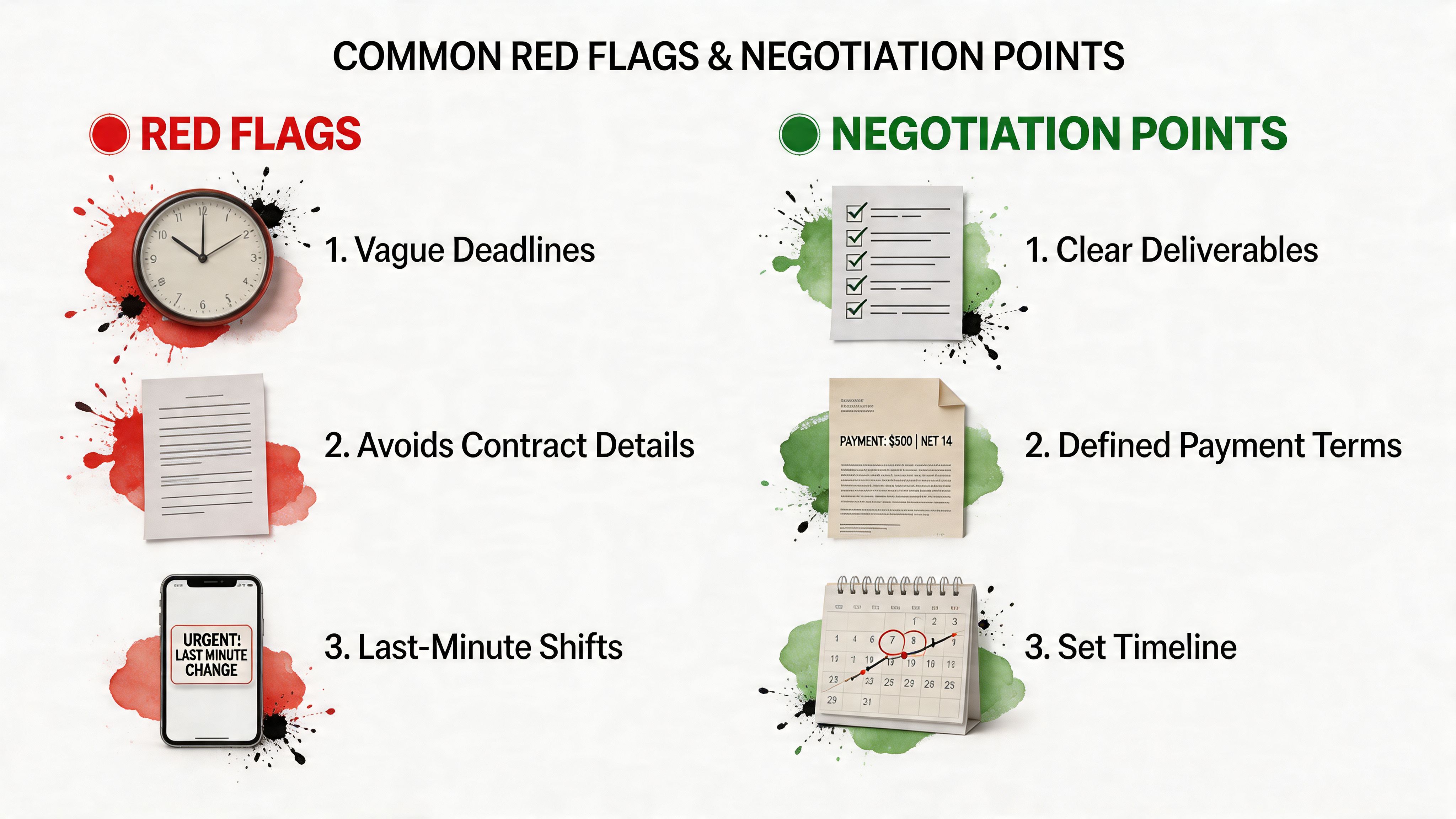
Vendors write contracts to protect revenue, reduce support burden, and avoid open-ended liability. That’s normal. Your job is to spot where that drafting pushes too far and then push it back to a workable middle.
The biggest operational red flag is vague scope. According to ABS reporting on scope creep in mid-sized enterprises, 68% of mid-sized enterprises experienced scope creep, which led to 15 to 22% budget overages due to poorly defined service scopes in MSAs.
Ambiguous scope creates open-ended cost
Vendors often prefer broad language like “related services,” “reasonable support,” or “implementation assistance as required.” That wording gives room to bill for extras later or to deny work your team assumed sat inside the fee.
Your counter is straightforward.
- Define the service boundary: List what sits in scope and what sits out of scope.
- Tie change to approval: Require written approval before extra work starts.
- Match payment to output: Connect fees to deliverables, milestones, or recurring service units.
A clear scope does two things. It limits surprise invoices, and it gives finance a usable basis for accruals and forecast checks.
One-sided commercial terms weaken your position
Some clauses look harmless because they sit in standard wording. They still need negotiation.
| Vendor goal | Red flag in the MSA | Your counter-move |
|---|---|---|
| Preserve margin | Unilateral price change rights | Require mutual agreement or a notice period with a termination right |
| Limit remedies | Low liability cap for the vendor | Tie the cap to a meaningful contract value |
| Lock in revenue | No termination for convenience | Add a practical exit right with clear notice |
| Shift risk | One-way indemnity in the vendor’s favor | Make indemnities mutual and tied to actual fault |
| Reduce service burden | Weak or vague SLA language | Define service levels, measurement, and remedies |
Negotiation lens: Ask what the vendor can change without your consent, what they can charge without approval, and what happens if they fail.
This isn’t about winning every point. It’s about removing terms that create avoidable operational drag later.
Auto-renewal traps hide in routine language
Auto-renewal clauses often sit near the back of the contract, written in routine terms, then turn into budget noise a year later. The common problem isn’t that auto-renewal exists. The problem is that nobody tracks the notice window, owner, or fee change trigger.
A good negotiation move is to tie renewal to clear notice rules, with named dates and cancellation mechanics that finance can track. A weak clause leaves too much to email chains and memory.
For a practical example, a 100-person company with agency, software, and contractor agreements may have contracts spread across inboxes, shared drives, and accounting notes. One missed notice can create a five-figure surprise. That example is hypothetical, but the workflow problem is common.
How to Track and Manage Your MSAs
To track and manage your MSAs, you need one register, extracted contract fields, and clear owners.
A signed master service agreement has no value if nobody can answer four questions. When does it renew. How much notice does cancellation need. What fees can change. Who inside the business owns the relationship.
That gap shows up in spend data. According to Xero 2025 Spend Intelligence data on MSA auto-renewals, 42% of mid-market companies in Australia report uncontrolled auto-renewals via MSAs, causing 12 to 18% in annual spend waste.
Step one, build one contract register
Start with a single register for every vendor agreement, software and services together. Don’t split software into one list and agencies or contractors into another. The same renewal risk appears in both.
For each agreement, record vendor name, contract type, effective date, end date, renewal structure, notice window, owner, payment terms, and where the signed document lives.
Step two, extract the fields that matter
Don’t extract everything. Pull the terms that change money or control.
- Renewal terms: End date, auto-renew language, notice requirement.
- Commercial terms: Fee schedule, uplift language, billing frequency.
- Operational terms: SLA commitments, response times, reporting duties.
- Exit terms: Termination rights, cure period, transition support.
A hypothetical company with 80 vendor agreements doesn’t need a perfect legal summary for each contract. It needs a usable operating record that supports renewal decisions before deadlines hit.
Ensurva Kira integration fits into this category of contract review workflow. Ensurva is a vendor management platform that tracks software and human service vendors in one system.
Step three, assign owners and review dates
Every agreement needs one business owner and one review date before the notice deadline. Without ownership, the contract sits in shared custody, which usually means no custody.
A contract register fails when it stores documents but doesn’t trigger decisions.
Set a recurring review cadence. Finance checks fee impact and renewal timing. Operations checks usage and service fit. The business owner decides whether to renew, renegotiate, or exit. That’s the part most legal-heavy guides skip, and it’s the part that controls spend.
Frequently asked questions
| Question | Answer |
|---|---|
| What’s the difference between a master service agreement and a statement of work? | A master service agreement sets the standing rules for the vendor relationship. A statement of work defines the specific work, deliverables, timing, and fees for a project or service period. |
| Does every vendor need a master service agreement? | No. A one-off low-risk purchase may not need one. Ongoing service relationships usually do, especially when the vendor handles data, has recurring fees, or may deliver multiple projects over time. |
| What clause causes the most trouble in a master service agreement? | Scope language causes frequent problems because vague service descriptions create billing disputes and delivery arguments. Termination and auto-renewal clauses also create trouble when nobody tracks dates and notice windows. |
| Who should own a master service agreement inside the company? | Legal may review the contract, but the business owner should own day-to-day accountability. Finance should track fees and renewal timing, while operations or IT should check service use and vendor performance. |
| Can a finance manager manage MSAs without a legal team? | Yes, for tracking, renewal control, and commercial review. A finance manager can keep the register, extract key terms, and flag risk. For major edits or unusual liability terms, legal review still matters. |
See how Ensurva tracks software and human service vendors in one system. Book a Demo
Authored using Outrank tool