

A master service agreement matters when a vendor relationship lasts longer than one project and touches real money, data, or delivery risk. If an operations manager treats it like routine paperwork, the company will miss renewal dates, absorb bad pricing, and argue over work that should have been defined upfront.
Table of Contents
- Termination controls the exit
- Liability sets the financial boundary
- Service levels define performance
- Auto-renewal creates preventable spend
- What does a master service agreement do?
- Is an MSA legally binding without a statement of work?
- Who should review a vendor MSA inside the company?
- What’s the biggest operational risk in an MSA?
- Can a small company negotiate a vendor’s standard MSA?
What Is a Master Service Agreement
A master service agreement is a framework contract that sets the core rules for an ongoing vendor relationship.
That’s the practical definition. It doesn’t describe the project itself. It sets the standing terms that will govern every future project, order, or service change between the company and the vendor.
A good master service agreement handles the durable issues once. It covers payment mechanics, confidentiality, liability, dispute handling, term length, termination rights, and ownership of work product. After that, each new piece of work should move faster because the parties don’t need to renegotiate the same foundation every time.
For an operations manager, that matters because vendor relationships rarely stay tidy. A software provider adds implementation support. An agency starts with one campaign, then takes on reporting and creative work. A contractor relationship turns into rolling monthly retainers. The MSA keeps those changes from turning into email-thread procurement.
Practical rule: If the company expects repeat work, recurring fees, or ongoing access to systems or data, it needs a master service agreement before the relationship grows.
A master service agreement also forces the company to decide how much ambiguity it will tolerate. That’s where many teams fail. They sign broad language because the first engagement feels small, then carry that weak paper into a much larger spend commitment.
For more operator-focused writing on vendor discipline, see Ensurva insights.
How MSAs Differ from SOWs and Vendor Contracts
An MSA is a rulebook that governs the relationship, while an SOW defines the work for a specific project.
Teams confuse these documents all the time, and that confusion slows work or creates risk. The cleanest way to think about it is this. The master service agreement sets the standing commercial and legal terms. The statement of work, or SOW, sets the deliverables, deadlines, fees, and project scope for one engagement under that framework.
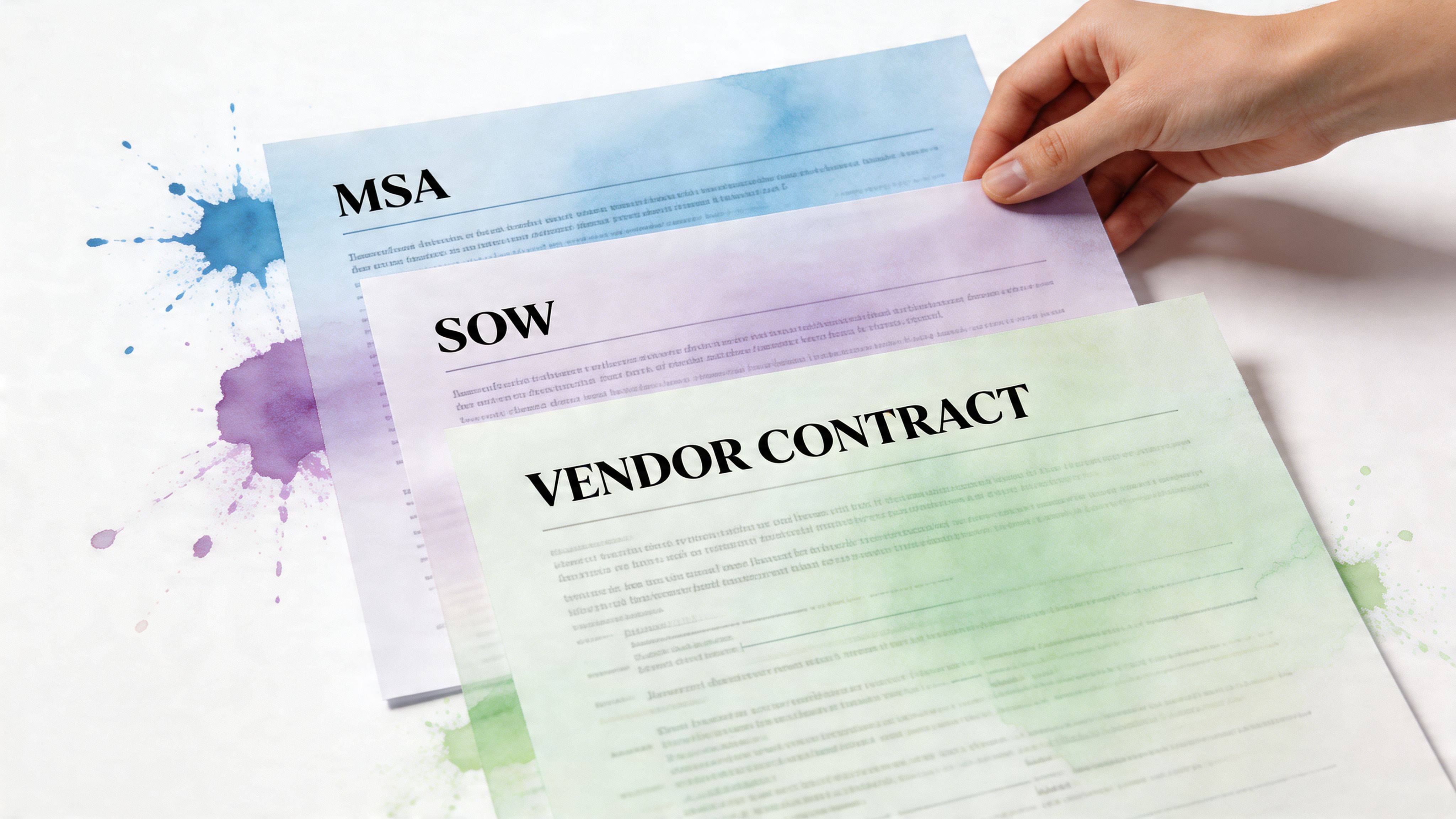
A vendor contract is the broader category. Sometimes the MSA is the vendor contract. Sometimes the vendor contract is a short standalone agreement with no layered SOW structure. The point isn’t the label. The point is whether the company has separated the reusable terms from the project-specific terms.
What belongs in each document
| Document | Main job | Typical content |
|---|---|---|
| Master service agreement | Set permanent relationship terms | Liability, confidentiality, payment rules, dispute process, termination rights |
| SOW | Define one piece of work | Deliverables, timeline, owner, acceptance criteria, project fee |
| Standalone vendor contract | Cover a one-off arrangement | A mix of both, often in one document |
This distinction matters most when the company works with the same vendor repeatedly. If the team buries everything inside one long project contract, every new project turns into a full renegotiation. That wastes time and creates version-control problems.
The MSA should stay stable. The SOW should change often.
A useful internal test works well here. If a term would still apply to the next project, it belongs in the MSA. If it only matters to this month’s deliverable, it belongs in the SOW.
Key Clauses You Must Scrutinise
Key MSA clauses are the terms that decide how the company exits, pays, measures performance, and absorbs risk.
Operators require discipline. In Australia, disputes arising from master service agreements account for about 25% of commercial contract litigation cases, with claimed damages above AUD 1.2 billion between 2018 and 2023, and 68% of those disputes stem from ambiguous scope of services or pricing adjustments, according to Monjur’s write-up on key MSA components. That isn’t a legal curiosity. That’s a warning about loose drafting.

Termination controls the exit
Termination is the first clause to read because it tells the company how trapped it is.
Look for three things. First, whether the company can terminate for convenience. Second, how much notice the vendor requires. Third, whether any fees survive termination beyond work already delivered. A fair clause gives both sides a clear path out with defined notice and a clean payment rule for completed work only.
A bad clause turns a weak vendor into a budget problem. If the company can’t leave without paying out the full remaining term, the vendor is in a strong position.
Liability sets the financial boundary
Liability language decides who pays when something goes wrong and how much they pay. The operator’s job is to stop vague exposure from creeping into a manageable vendor relationship.
The company should push for liability caps tied to what it pays the vendor, not some inflated number that bears no relation to the contract. It should also check carve-outs carefully. Vendors often try to keep the cap for their own obligations while expanding the client’s indemnities.
For the company’s own record-keeping and approval process, Ensurva terms and conditions offer a simple example of why clear legal language matters.
Service levels define performance
Service levels matter when the vendor runs something ongoing, not when the relationship is only advisory. If the vendor hosts software, supports a workflow, processes requests, or promises response times, the MSA or attached SOW should state the measurable standard and the remedy for failure.
Without that, the company has no clean way to challenge bad service. “Commercially reasonable efforts” won’t help the finance team explain missed service with full invoices still arriving on time.
If a vendor promises continuity, uptime, turnaround, or support, the company should demand a measurable standard and a stated remedy.
Auto-renewal creates preventable spend
Auto-renewal language often sits near the back of the agreement, and teams ignore it until the notice window has closed.
The company should check the renewal trigger, the notice period for non-renewal, and any linked price increase mechanics. A vendor can write a short notice window and a quiet evergreen clause, then rely on the fact that nobody tracks the contract after signature.
Operations usually owns the mess. The fix isn’t legal sophistication. It’s disciplined review and disciplined tracking.
Negotiating Your MSA and Spotting Red Flags
To negotiate an MSA well, the company must align risk before it argues over wording.
Most weak MSAs come from rushed commercial decisions, not clever legal drafting. A vendor sends paper. Someone wants the work to start. The team redlines in a hurry, accepts broad terms, and hopes the relationship stays friendly. That’s not negotiation. That’s deferring a problem.
Start with commercial positions
The better approach starts with firm stances in plain English. The company should decide, before markup, where it stands on liability cap structure, data ownership, termination for convenience, service credits, notice periods, and renewal mechanics.
A short internal list keeps the discussion clean:
- Define the cap: Ask for liability limits that match the contract economics.
- Protect the exit: Require a practical termination right and a notice period the team can manage.
- Narrow the scope: Force the vendor to state what it will not do, not only what it might do.
- Fix the renewal clock: Tie notice windows to tracked dates, not buried boilerplate.
Under Australian Competition and Consumer Act 2010 jurisdiction, MSAs must include calibrated liability and indemnification clauses, and caps on consequential damages are often set at 12 months’ fees, which can average AUD 150,000 for software vendors, as reflected in this example agreement archived by the SEC.
Walk away from one-way risk transfer
Some red flags should end the discussion unless the vendor moves.
A one-sided indemnity is one. So is a clause that lets the vendor raise fees with weak notice or vague discretion. Another is an intellectual property clause that hands the vendor rights over material the company paid to create or data the company supplied.
A clear hypothetical helps. A 100-person company hires a service provider to build internal workflow assets and reporting logic. If the vendor’s paper says the vendor owns all derivative work, the company may end up paying to recreate its own operating system after termination. That’s not a drafting nit. That’s a control problem.
Ask one blunt question during negotiation. If this vendor relationship fails in six months, which clauses will make the exit expensive or messy?
If the answer includes ownership, termination, or renewal, the company hasn’t finished negotiating.
Tracking MSA Terms to Prevent Surprise Spend
To prevent surprise spend, the company must track the commercial terms after signature.
A signed master service agreement doesn’t protect anyone if nobody tracks what it says. That’s where operators lose money. The issue usually isn’t that the company lacked a contract. The issue is that the contract sat in a folder while renewal dates, notice periods, fee schedules, and service obligations drifted out of view.
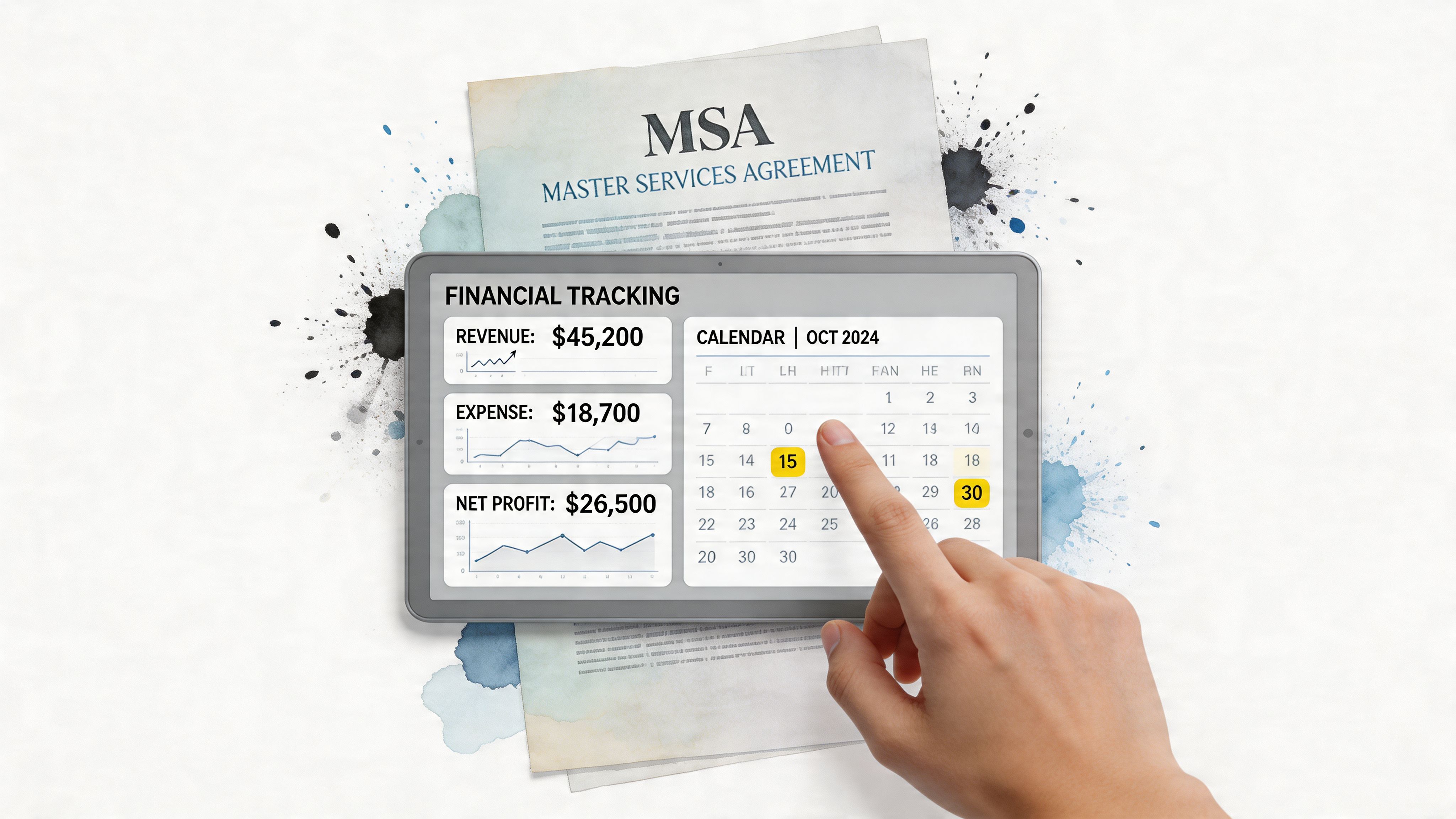
Australian businesses that formally manage MSAs achieve 35% better visibility into renewal dates and fee schedules, helping them avoid part of the AUD 2.5 billion in national auto-renewal penalties that SMEs pay annually, according to Axiom’s guide to master service agreements.
Track the terms that move cash
An operations manager should extract and maintain a live record of:
- Renewal dates: Include the exact non-renewal deadline, not only the contract end date.
- Fee schedules: Record base fees, usage triggers, and any increase mechanism.
- Termination notice: Store the notice method, recipient, and lead time.
- Service commitments: Note any service levels that affect payment disputes or credits.
If the company still tracks this in scattered spreadsheets and inboxes, it should expect avoidable misses. A practical explanation of that problem appears in this article on outgrowing spreadsheets.
The category matters here. Ensurva is a vendor management platform that tracks software and human service vendors in one system. That matters because many companies don’t overspend only on software. They also lose control of agency, contractor, and service-provider commitments that sit under the same renewal and scope problems.
Frequently asked questions
What does a master service agreement do?
A master service agreement sets the standing legal and commercial rules for an ongoing vendor relationship. It usually covers liability, confidentiality, payment terms, dispute handling, renewal, and termination, so future work can sit under one stable framework.
Is an MSA legally binding without a statement of work?
Yes, it can be legally binding on its own, but it may not create a payment obligation or delivery commitment until the parties sign an order form, SOW, or other work document. The MSA sets the rules. The project document triggers the work.
Who should review a vendor MSA inside the company?
Operations should review the commercial terms, finance should review pricing and renewal mechanics, and legal should review risk allocation. If the company lacks in-house legal support, operations still needs a checklist and a clear approval path before signature.
What’s the biggest operational risk in an MSA?
The biggest operational risk is untracked commercial terms. Auto-renewal clauses, notice deadlines, vague pricing adjustments, and weak scope definitions create spend problems long after the agreement is signed.
Can a small company negotiate a vendor’s standard MSA?
Yes. A small company doesn’t need procurement theatre. It needs clear positions on liability, termination, renewal, scope, and ownership. Good vendors negotiate those points every day. Weak vendors often rely on the fact that nobody asks.
See how Ensurva tracks software and human service vendors in one system. Book a Demo [link: www.ensurva.com/book-demo]
Written with Outrank app